

Divorce in Singapore: What to Consider Before You Settle
The process will take things out of your hands. The settlement doesn’t have to.
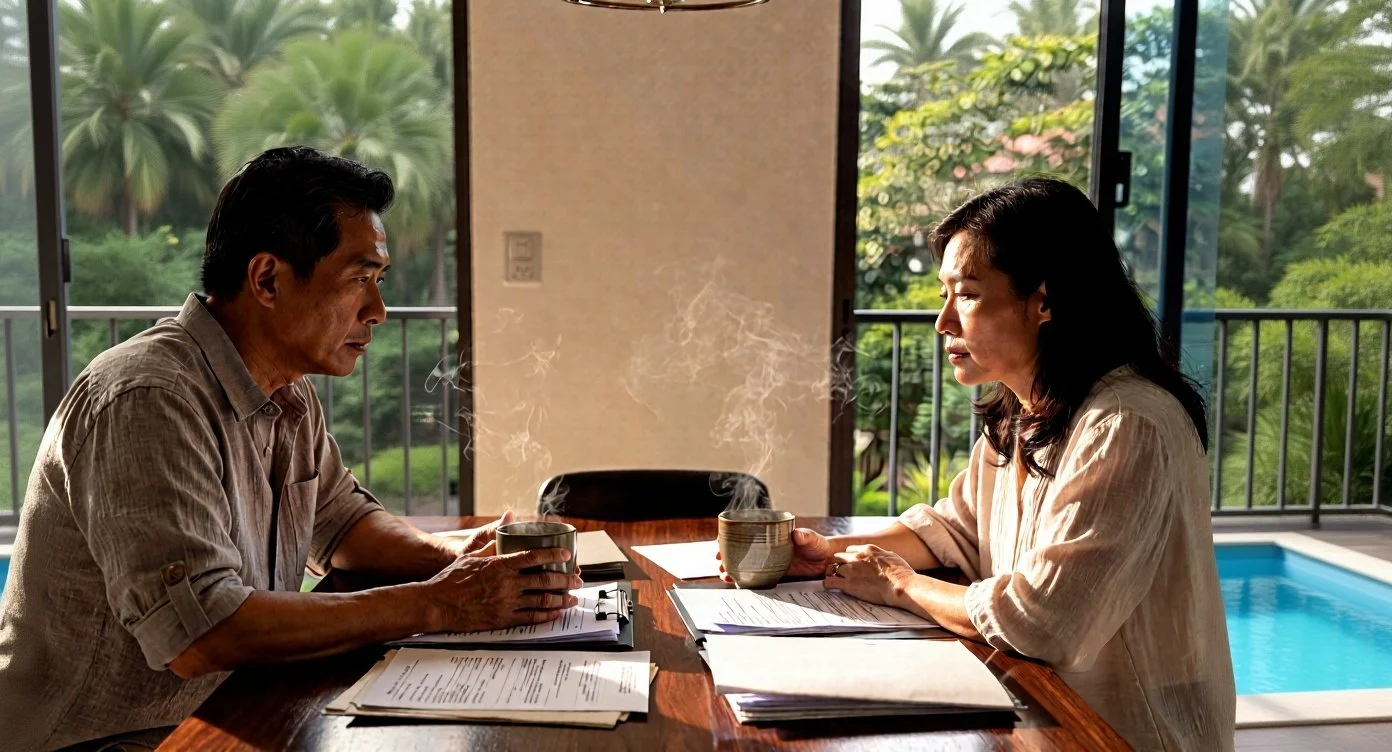
There is a particular loss that comes with divorce that nobody quite prepares you for. Not the emotional loss, though that is its own thing entirely. It is the loss of agency. The feeling of being a competent, capable person — someone who has built a career, run a business, made good decisions under pressure — and suddenly finding yourself a passenger in proceedings that are happening to you rather than being shaped by you.
Lawyers file documents. Timelines move or don’t move. Positions harden before you’ve had time to think clearly about what you want. And beneath all of it is the unsettling awareness that decisions are being made, or are about to be made, that will define what your financial life looks like for years after this process is over.
That feeling is understandable. Much of the process genuinely is outside your control.
But the settlement is not. And that distinction matters more than most people realise until it’s too late to act on it.
What the settlement is — and when it happens
Divorce in Singapore unfolds in two stages. The first is the Interim Judgment of Divorce, granted by the court once the legal grounds for dissolution are established. This is the moment most people experience as the finish line — the formal recognition that the marriage is over. The relief is real. So is the exhaustion that comes with it.
But the Interim Judgment does not resolve how assets are divided, who pays maintenance, or how children’s arrangements are structured. Those decisions come next, through what the courts call ancillary matters. The consent order that formalises the settlement, and makes it legally binding, is issued only once ancillary matters are resolved.
This is the part most people underestimate. Ancillary matters are negotiated at the moment of greatest exhaustion, when the instinct is to agree quickly and move on. The decisions made here — on matrimonial assets, maintenance, and children’s arrangements — will shape the financial reality of your life long after the proceedings are over. They deserve more careful thought than the timing naturally allows for.
Since July 2024, couples can file for Divorce by Mutual Agreement, removing the need to assign blame for the breakdown. The route taken affects the proceedings, but not the principles the court applies when dividing assets. Whichever way the divorce is filed, the ancillary matters remain — and so does the importance of thinking them through clearly before positions are locked in.
Under Section 112 of the Women’s Charter, the court divides matrimonial assets on a “just and equitable” basis. This does not mean an equal split. It means the court weighs both direct financial contributions and indirect contributions, such as homemaking and childcare, alongside the duration of the marriage, the needs of any children, and the overall circumstances. In practice, the outcome varies considerably depending on the facts.
An equal division of assets, when it does occur, does not produce equal outcomes. A split that reads as fair in a consent order can leave one party with obligations they cannot sustain, assets they cannot access, or a financial position that makes rebuilding genuinely difficult. Understanding why requires looking at each asset not just for its stated value, but for what it does in a life.
What happens to Central Provident Fund (CPF) savings in a divorce
CPF savings accumulated during the marriage form part of the matrimonial asset pool, and the court can order their division. There are two mechanisms: a transfer order, which moves funds directly from one party’s CPF accounts to the other’s corresponding accounts, where they remain subject to CPF withdrawal rules; and a charging order, under which the receiving party is paid in cash, but only when the other party becomes eligible to withdraw their CPF savings.
This distinction matters considerably in practice. Under a transfer order, the receiving party can use the funds for CPF-approved purposes immediately but cannot simply withdraw them as cash. A settlement that assigns a large CPF balance to one party whilst the other retains liquid assets may look balanced on a spreadsheet. In practice, one party has flexible capital and the other has a long-term asset tied to withdrawal conditions that may be years away.
This is the kind of asymmetry that is easy to miss when assets are assessed by headline value rather than by how they function in a life. It is also one of the most common sources of post-settlement regret.
Where people give away control without realising it
The decisions most often regretted are rarely the ones that felt obviously wrong at the time. They are the ones made under time pressure, without a clear enough picture of their consequences, at the point in negotiations when the desire to resolve something overtakes the discipline to resolve it well.
Housing
Retaining the matrimonial home can feel like stability. Sometimes it is. But it also means absorbing the full carrying cost of a property that may represent a disproportionate share of total assets, whilst potentially limiting liquidity at precisely the moment when flexibility has the greatest value. Selling feels like loss. It can also be the decision that makes everything else workable. Neither answer is automatically right. What matters is that the choice is yours to make — not one you drift into because negotiating feels harder than simply conceding.
Asset composition
Not all assets are equal, even when the numbers say they are. CPF balances, liquid investments, property, and business interests each work differently and carry different constraints. A settlement that looks balanced on paper can function very differently in practice.
Maintenance
Spousal and child maintenance commitments reshape income and expenses on both sides of the settlement. A settlement that looks workable in isolation can become very tight once the full picture is laid out. Whether you are accepting lower maintenance in exchange for a larger asset share, or committing to higher maintenance whilst retaining less, the outcome depends entirely on the nature of those assets and the actual cost of the life ahead.
Before the consent order is signed
The legal process determines what is fair according to established principles. It does not determine whether the outcome is appropriate for your specific situation, or whether it supports the life you are trying to build.
That layer of assessment is yours to do. And the time to do it is not in the final stages of negotiation, when positions are locked and the pressure to conclude is at its highest. It is before that, when options are still open and the thinking can happen without a deadline attached to it.
In practice, this means understanding what each asset means for your liquidity, your income, and your obligations going forward. Knowing what a sustainable post-settlement financial position requires, not optimistically, but accurately. And identifying, before the consent order is signed, which concessions would cost you most in practice, so that the things that matter most are the things you protect.
Getting that picture in place early changes the quality of every decision that follows. Not because it guarantees a better outcome from the negotiation, but because it means you enter that negotiation knowing what you need, rather than discovering afterwards what you should have asked for.
The settlement is the beginning, not the end
What the settlement does is set the terms of what comes next. The assets you walk away with, the obligations you carry, the financial position you are starting from — these are the raw materials of the chapter that follows. The quality of that chapter depends significantly on how clearly you assessed those materials before you agreed to them.
The best divorce settlements are not the ones that felt most fair in the room. They are the ones that still feel right two years later, because you thought carefully, before the pressure arrived, about what you were agreeing to and what that agreement would mean in a life.
WE'D WELCOME A CONVERSATIONWhen you’re ready to look at what comes next, we’d be glad to sit down with you. . Our starting point is always a Discovery — a conversation where we take a complete picture of your life as it stands now: what you have, what you need, what you're building towards. From that clarity, everything else follows.